01 / Inner Atlas
Identity
Consider the stories, roles, and continuities that make a sense of self feel familiar.
- Which description of yourself feels useful today?
- What remains when a role is set aside for a moment?
An independent creative platform
A space for encountering consciousness, perception, reality, time, and the texture of human experience.
A field for inquiry
Beyond Timelines brings visual work and open-ended inquiry into a considered digital space. It is an invitation to pause, look again, and make room for what resists easy definition.
Featured collection
Explore the complete Transpersonal Images collection, or take a suggested route through its visual field.
Explore the collectionPermanent creative archive
Each collection pairs a visual route with a distinct line of inquiry. The four editorial pathways are available below alongside the complete Transpersonal Images archive.
47 original artworks, available in a responsive, immersive gallery.
Enter the galleryA map of human experience
Choose a destination to follow a short path of questions, connected collections, and suggested visual routes. This is an exploratory map, not an assessment or diagnosis.
Choose one of six destinations. Each opens a concise reflection with links to a related pathway and suggested gallery route.
Select a destination to begin.
01 / Inner Atlas
Consider the stories, roles, and continuities that make a sense of self feel familiar.
02 / Inner Atlas
Notice the difference between an experience and the attention that meets it.
03 / Inner Atlas
Explore change as a lived process: uneven, unfinished, and open to more than one reading.
04 / Inner Atlas
Approach dream experience as material for curiosity, without needing to settle its meaning.
05 / Inner Atlas
Follow the ways significance is made, shared, revised, and sometimes left unresolved.
06 / Inner Atlas
Attend to memory, anticipation, and the present moment as distinct but interwoven experiences.
Your choices remain in this browser session only and are not saved or sent.
Interactive environment
These optional experiences offer prompts and perspectives rather than answers. They store nothing, make no diagnostic claims, and can be entered in any order.
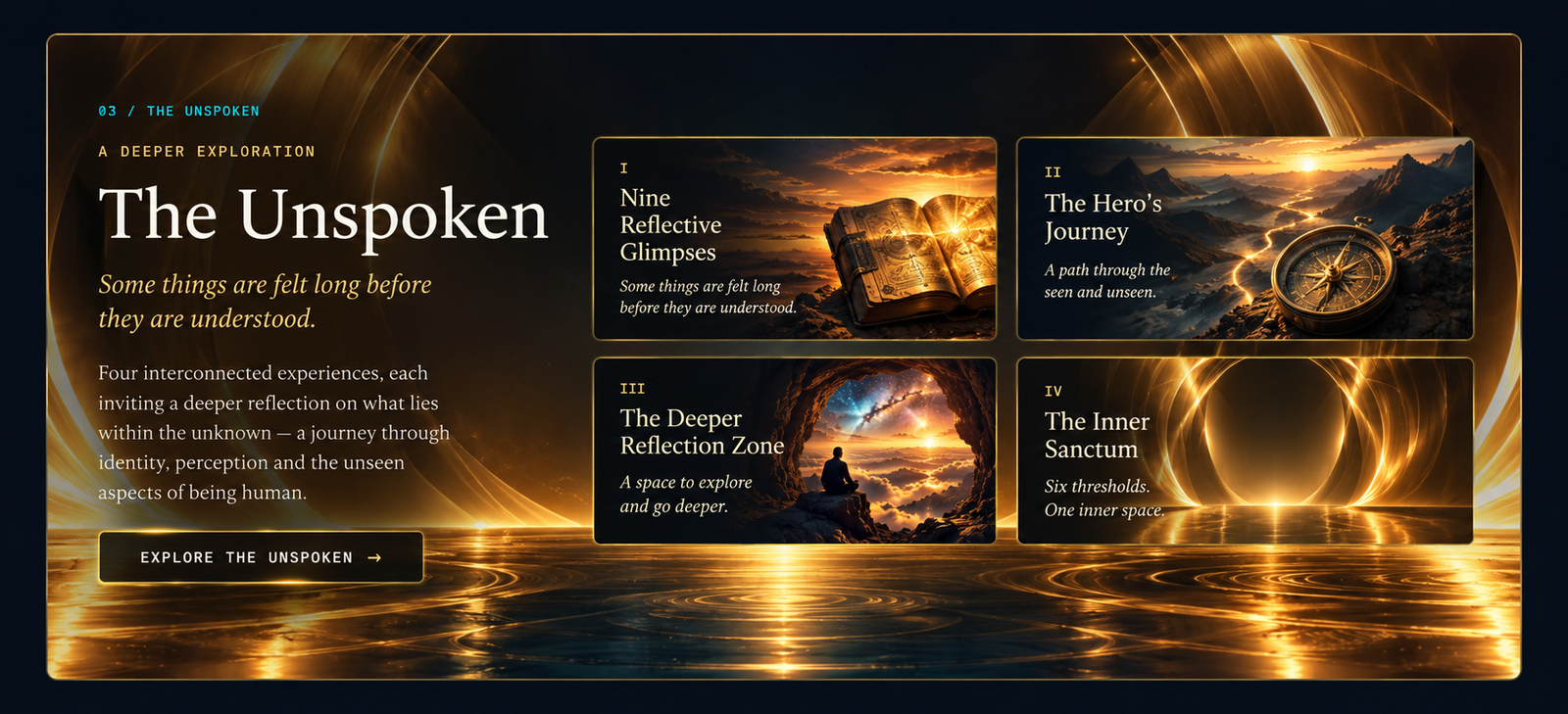
A short interactive reflection on observation, awareness, and thought. It asks for no answer and stores nothing.
The Journey Within
You arrived in the world before you had a story about who you were. Over time, that story formed around you. But is the story all that you are?
This is a secular, reflective experience—not therapy, diagnosis, or instruction. Move at your own pace, skip any chapter, and leave whenever you wish.
Nine chapters are available. Choose any point of entry.
01 / Before the story
A room before language: changing light, an unfamiliar sound, the pressure of being held. Before a person can describe a life, life is already happening.
Early experience is not a blankness. Sensation, relation, rhythm, and response arrive before an autobiographical account of them. This opening chapter asks what it means to be alive before a developed story of “me” has taken shape.
Every person begins within conditions they did not select: bodies, caregivers, sounds, routines, languages, and social worlds already in motion. It is tempting to talk about the beginning of life as if awareness were simply absent until a narrative self appears. That shortcut is too blunt. Infants respond, orient, regulate, attach, and participate in relationships long before they can report a history. What arrives later is not experience itself but a particular ability to organise experience around remembered events, names, roles, and explanations. The distinction matters because it softens a familiar assumption: that what cannot yet be told is not significant. A life may be forming patterns before it has words for them, without those patterns dictating a permanent fate.
Early relationships can offer comfort, uncertainty, delight, strain, or many shifting combinations. No visitor needs to turn this chapter into a verdict on childhood. Family structures, cultures, resources, migration, illness, and chance make beginnings radically different. The reflective question is smaller and more humane: what kinds of welcome, expectation, or atmosphere became familiar? Looking back may reveal a texture rather than a single cause. A person can recognise that early conditions mattered while also resisting the story that they explain everything. In this experience, “arrival” names the continuing fact that bodies and minds meet a world before they understand it.
Autobiographical identity eventually creates continuity: I was there; this happened to me; this is what it meant. That continuity is valuable, but it is not the only register of human life. Sensation, relationship, and attention continue beneath the summaries we make. The metaphor of an inner self begins here not as a hidden supernatural object, but as an invitation to notice that a person is more than the story currently being told about them. This is a philosophical and experiential possibility, not a scientific conclusion. It asks whether the capacity to meet the present may be older, wider, or quieter than the biography that now occupies the foreground.
Reflective questions
Optional exercise
Choose an option, or continue without using the exercise.
Connection: Susan Blackmore’s work is a useful prompt to examine how a stable sense of self may be constructed rather than simply discovered intact.
Explore consciousnessOpen Inner AtlasSuggested artworksTake what feels proportionate. The next chapter is available, but no sequence is required.
02 / The world enters us
A phrase repeated at a table. A look that earns approval. A rule that becomes invisible because everyone around it treats it as ordinary.
Language, belonging, and expectation help form a person. Conditioning here does not mean that anyone is mechanically programmed; it names the many ways a world becomes familiar enough to feel like nature.
Families, peer groups, schools, neighbourhoods, work cultures, and media each offer ways to interpret what matters. We learn how to greet, what to hide, which futures appear plausible, and what kinds of difference are rewarded or feared. Much of this learning is practical and necessary. It makes coordination possible; it can carry care, humour, language, and belonging across generations. Yet familiar assumptions can become difficult to see precisely because they work so quietly. The purpose of examining conditioning is not to reject one’s background or blame those who offered it. It is to make room for a question: which inherited patterns still serve a life, and which have become too narrow for present circumstances?
Approval can guide development without being the whole story. People adapt differently to similar environments, and environments themselves change. One person may become attentive to harmony; another may prize independence; another may learn to move between several cultural languages. None of these responses should be read as a diagnosis. They are possible descriptions of adaptation. The risk appears when an old adaptation is treated as an unchangeable identity. A learned belief can feel self-evident because it once helped someone belong, stay safe, make sense, or avoid conflict. Noticing that history does not require disowning the belief. It allows a person to hold it with more choice.
Words do not merely label a finished world; they also give attention a path. A community’s available language can make certain feelings easy to share and others hard to name. This does not mean language traps everyone inside a fixed reality. It means that interpretation is social as well as private. The Lens pathway explores this further: observation and inference can be distinguished even when they occur quickly. In this chapter, the useful pause is simple. Before assuming that a reaction is “just who I am,” ask whether it might also be a learned response, one among several possible ways of meeting the same situation.
Reflective questions
Optional exercise
Choose an option, or continue without using the exercise.
Connection: Jung’s persona can be read as a historical psychological idea about the social face through which people meet a world.
Explore perceptionOpen Inner AtlasSuggested artworksTake what feels proportionate. The next chapter is available, but no sequence is required.
03 / The person we become
A name on a form. A role spoken aloud. A photograph that seems both recognisable and unexpectedly distant.
Identity offers continuity and orientation. It can also become tight when a person must defend a role that no longer fits their lived experience. It can be revised with care without becoming a demand to discard history, loyalty, or belonging.
A person moves through many roles: friend, parent, child, colleague, maker, carer, learner, neighbour, stranger. Roles are not necessarily masks in a dishonest sense. They are social practices that let responsibilities and relationships take shape. Difficulty can arise when one role claims to be the complete person, or when an image maintained for others becomes impossible to inhabit alone. The question is not whether to discard every role. It is whether there is room to recognise the difference between a useful role and the totality of a self. That distinction can bring relief without requiring a dramatic reinvention.
Self-image often gathers around competence, desirability, morality, success, affiliation, or a story about what one has survived. Such images can be stabilising. They can also make contradiction hard to tolerate. A person may defend being capable while needing help, defend being independent while wanting closeness, or defend being kind while discovering anger. Contradiction is not proof of failure. It is information about a life that exceeds a single label. The Mirror of Identity chamber treats these tensions as three perspectives rather than a test: what was learned, what is currently believed, and what may be becoming.
Jung distinguished the ego from a broader psychological concept of the Self. This site uses that distinction carefully: it is part of a historical theory, not a map of proven inner anatomy. As a reflective tool, it can help someone ask whether the narrative voice saying “this is me” is the only voice worth hearing. Blackmore’s critical work offers a different provocation: the sense of a unified self may be assembled from many processes. These approaches do not need to agree in order to be useful. They invite intellectual humility about what a stable “I” is and how it is experienced.
Reflective questions
Optional exercise
Choose an option, or continue without using the exercise.
Connection: Jung’s persona and Self, and Blackmore’s questions about the constructed self, are contrasting influences rather than conclusions this experience asks visitors to adopt.
Explore consciousnessOpen Inner AtlasSuggested artworksTake what feels proportionate. The next chapter is available, but no sequence is required.
04 / Something no longer fits
The usual answer arrives too quickly. A route once familiar begins to feel like a sentence spoken in someone else’s voice.
Questioning can emerge through curiosity, transition, dissatisfaction, loss, delight, or a quiet sense that a former arrangement no longer fits. It does not require a crisis to be real, nor does it need immediate explanation. A question can be held provisionally while practical life continues.
Joseph Campbell described a recurring narrative movement of departure, initiation, and return. As a story pattern, it can illuminate the felt experience of stepping away from the familiar. It should not become a rulebook. Not everyone experiences change as a heroic departure; not every uncertainty contains a hidden calling; many lives develop through continuity, care, and small revisions. The value of the metaphor is its modesty: it notices that a question can move a person beyond an old map before a new one exists. The Journey Within uses “the call” as an optional lens for that moment, not as a demand to abandon ordinary responsibilities or make major decisions.
A question can be important without becoming an emergency. Sometimes the most honest response to “something no longer fits” is to remain curious long enough to learn what the discomfort is and is not asking for. It may concern work, relationship, body, community, creativity, or a change in values. It may also pass. This is why the experience avoids scores and prescriptions. It cannot know what a visitor should do. It can offer a place to name a transition, distinguish pressure from possibility, and notice the difference between a desire for a different feeling and a choice that is ready to be made.
Thresholds are often ordinary: an ending, a question asked out loud, a new responsibility, a pause before replying. They can be meaningful without being mystical. Campbell’s language of the threshold is useful when it is kept flexible; it gives form to uncertainty without claiming to reveal an individual’s destiny. The next chamber presents several transition scenarios and multiple plausible responses. None is a diagnostic key. The aim is to practise holding more than one interpretation at once, especially when an old self-image asks for a quick answer.
Reflective questions
Optional exercise
Choose an option, or continue without using the exercise.
Connection: Campbell’s departure motif informs this chapter while its limitations are kept visible: a life is not required to resemble a myth.
Explore timeOpen Inner AtlasSuggested artworksTake what feels proportionate. The next chapter is available, but no sequence is required.
05 / What we have not met
A quality noticed first in someone else. A reaction that surprises its owner. A possibility left outside the story of being “the kind of person who…”
Jung’s shadow is often discussed as what a person disowns or does not readily recognise. Here it is approached with care: not every feeling conceals a hidden truth, and no exercise should become forced excavation.
People carry contradictions. A generous person may resent; a confident person may doubt; someone known for calm may feel intense anger; someone who values freedom may also want protection. The point of naming contradiction is not to expose a secret moral defect. It is to loosen the demand that a self-image remain perfectly consistent. Jung’s shadow offers one vocabulary for what falls outside a preferred picture of oneself. Other psychological approaches use different terms, and none should be treated as a machine for decoding every reaction. A useful question is gentler: what quality, need, fear, or possibility has not found an acceptable place in the current story?
It is easy to use the word projection against another person: “that is your shadow.” This experience does not do that. Projection is better held as a possibility to examine privately and tentatively. A strong reaction may arise from present facts, old learning, value conflict, fatigue, injustice, attraction, or many elements at once. It may include an unrecognised personal theme; it may not. No interactive prompt can settle that question. The ethical move is to distinguish observation from inference and to leave room for ordinary explanations. Reflection can add complexity without turning another person into a screen for private theory.
Meeting an unexpressed possibility does not mean acting it out. Someone can acknowledge anger while choosing a boundary, recognise longing while declining to pursue it, or notice fear without treating it as prophecy. Self-compassion includes the right to stop. This chapter does not ask visitors to retrieve memories, relive distress, or search for trauma. If a question feels too charged, skipping it is a valid and complete response. The work of integration, in this modest sense, is not to become flawless; it is to make a little more room for truthfulness, responsibility, and choice in ordinary life.
Reflective questions
Optional exercise
Choose an option, or continue without using the exercise.
Connection: Jung’s concepts of persona and shadow are presented as historical psychological ideas, with explicit limits on how they are applied here.
Explore realityOpen Inner AtlasSuggested artworksTake what feels proportionate. The next chapter is available, but no sequence is required.
06 / Between two lives
The old door is open behind you. The next room is not yet visible. A person can stand there longer than any story of courage allows.
A threshold names uncertainty between familiar roles and emerging possibilities. It can involve loss or relief, and it does not require suffering to be meaningful. Some thresholds are chosen; others arrive through circumstance. In either case, no single feeling or decision proves what the change means. It may be a transition with no single lesson, and it can still deserve patience, practical care, and respect.
Between two lives, certainty can be scarce. A former role may have ended before a new one feels credible; a relationship, workplace, body, or community may be changing faster than language can catch up. This interval is often described as a void, but that image can become melodramatic. It may be better understood as a practical condition of incomplete information. Not knowing does not make a person spiritually advanced or psychologically deficient. It simply means that an old map is insufficient. The challenge is to act with appropriate care while resisting the pressure to manufacture certainty for comfort.
Loss can alter a life without delivering a message. This experience does not glorify hardship or imply that distress is necessary for growth. People may find meaning after difficult events, but that meaning should not be forced onto the event itself or onto anyone else. A threshold can be approached with sorrow, gratitude, fear, ambivalence, or none of these. The useful distinction is between making space for a response and declaring that suffering was required. The first respects complexity; the second can make a person feel responsible for turning pain into a virtue.
At a threshold, a small reversible action can sometimes be more honest than a grand declaration. Asking a question, setting a boundary, requesting time, learning more, or speaking with someone trusted may be enough for now. The Threshold Chamber offers scenarios precisely to resist the idea that one response reveals a visitor’s “true” identity. Choices are contextual. They change with resources, obligations, safety, and values. The chapter’s invitation is therefore modest: move forward only as far as the available information, care, and responsibility allow.
Reflective questions
Optional exercise
Choose an option, or continue without using the exercise.
Connection: Campbell’s threshold imagery is used here as flexible narrative language, not as a map every life must follow.
Explore realityOpen Inner AtlasSuggested artworksTake what feels proportionate. The next chapter is available, but no sequence is required.
07 / The observer emerges
A familiar reaction starts, and for one brief interval there is room around it: enough room to notice before replying.
Awakening is used here as ordinary, ongoing metacognition: recognising a habitual pattern while it is happening and discovering a little more freedom in how to respond. It may be quiet, incomplete, and easily forgotten; those limits do not make the pause less real. Its value is measured by care and clarity, not by intensity or permanence.
Habits of thought and response are often efficient. They let people move through a complex day without deliberating over every action. A pattern becomes interesting when it repeatedly narrows a choice: an assumption appears, attention contracts, and a familiar response follows. Metacognition names the capacity to notice something about one’s own thinking. It does not require a special state, and it does not place anyone above ordinary human difficulty. A moment of noticing may be brief, partial, or followed by the same response as before. Its value lies in creating a small interval in which automaticity is no longer the only available description of what is happening.
Talk of presence can become another identity project: calm, pure, permanently awake. This experience rejects that image. Attention wanders; bodies tire; responsibilities continue. A reflective pause is not a clinical outcome or proof of superiority. It is simply a way of meeting the current moment with a little more precision. The Observer already offers a short practice of noticing thought, sensation, sound, or something else. The point is not to eliminate content from the mind. It is to recognise that content can be present without requiring immediate agreement, action, or self-definition.
Freedom in this context is relative, not absolute. Circumstances, relationships, obligations, and structural conditions matter. A person may not control what arrives, but may sometimes gain a fraction more choice in how to name, pause, ask, defer, or act. That fraction can be meaningful without becoming a promise that awareness solves suffering. Grof’s work on extraordinary subjective experience reminds us that consciousness can be interpreted through expansive frameworks; Blackmore’s critical stance reminds us to test explanations and avoid treating intensity as proof. The chapter holds both invitations: remain open to experience, and remain careful about what it establishes.
Reflective questions
Optional exercise
Choose an option, or continue without using the exercise.
Connection: Grof’s transpersonal models are discussed as speculative frameworks for some extraordinary experiences; Blackmore offers a contrasting critical emphasis on competing psychological explanations.
Explore consciousnessOpen Inner AtlasSuggested artworksTake what feels proportionate. The next chapter is available, but no sequence is required.
08 / Living what we recognise
Insight leaves the quiet room and meets a calendar, a conversation, a boundary, a piece of work that still needs doing.
Integration translates reflection into ordinary life: relationships, responsibility, work, creativity, rest, and boundaries. It is less a finish line than a continuing practice of bringing insight into contact with reality. It also leaves room for other people’s needs, practical constraints, and revision. An insight may need translating more than once as circumstances, relationships, and understanding continue to change.
An insight becomes more useful when it can coexist with other people’s reality. A person may realise that a role feels constraining, that a reaction has become familiar, or that a value needs more room. Integration asks how that recognition changes a conversation, a request, an apology, a limit, or a commitment. It does not require announcing every inner discovery. Often it is quieter: listening longer, being clearer, asking for help, declining what cannot be carried, or making time for a craft. The test is not whether an action looks transformed from outside. It is whether it fits the responsibilities and relationships a person actually has.
Compassion is sometimes mistaken for endless availability. Integration can include boundaries precisely because relationships need clarity to remain liveable. A boundary is not a punishment; it can be a description of what is possible, safe, fair, or sustainable. Likewise, responsibility does not require self-erasure. The reflective work in earlier chapters may reveal conflicting needs rather than a single authentic command. Integration means negotiating those conflicts over time, with attention to practical consequences. It should not be used to justify abrupt decisions or to demand that another person validate a private narrative.
Creativity can give form to questions that are not yet settled: a sketch, a walk, a reordered room, a piece of writing, a repair, a meal, a conversation. These acts need not become projects of self-improvement. They can be small ways of participating in a life that feels more deliberate. Campbell’s return motif is helpful here because it values bringing something back to ordinary life; its limitation is equally important. No one owes the world a dramatic gift after reflection. Sometimes the most honest return is a more attentive participation in the next available responsibility.
Reflective questions
Optional exercise
Choose an option, or continue without using the exercise.
Connection: Jungian individuation and Campbell’s return are used as interpretive influences, balanced by an emphasis on ordinary responsibility rather than heroic self-display.
Explore timeOpen Inner AtlasSuggested artworksTake what feels proportionate. The next chapter is available, but no sequence is required.
09 / Conscious living
The map closes. The street remains. Conversations, work, weather, care, uncertainty, and possibility continue to arrive.
The Journey Within ends by refusing a final ending. The return is renewed participation in life: learning, creativity, care, service, and continued revision rather than a ladder toward permanent enlightenment. No insight removes uncertainty or substitutes for the next ordinary act of attention. The question is not whether a person has arrived, but how they might participate with a little more honesty and care.
Campbell’s return motif suggests that a journey becomes meaningful when it re-enters ordinary life. Taken literally, that can sound like a demand to return with wisdom already secured. This experience makes a smaller claim. A person may return with a better question, a clearer boundary, a willingness to listen, or simply an awareness that certainty is limited. None of these guarantees a better future. They are forms of participation. The return is not proof that the journey has been completed correctly; it is an opportunity to bring whatever was noticed back into the next conversation, decision, relationship, or piece of work.
Earlier chapters do not stay behind in a fixed order. Arrival, conditioning, identity, call, shadow, threshold, awakening, and integration can recur across a life. A person may feel settled in one domain and uncertain in another; may discover a familiar pattern under new conditions; may revisit an old question with new language. The nine-stage map is therefore a navigational device, not a hierarchy. It has no score, no correct sequence, and no arrival badge. Visitors are free to begin anywhere, skip what does not fit, return later, or leave the experience entirely.
Conscious living need not mean constant self-observation. It can mean allowing attention, values, and responsibility to meet in a particular moment. It can include humour, uncertainty, error, repair, ordinary pleasure, and change. The final chamber asks about authenticity, relationships, awareness, and one small voluntary action—not because a website can know what a visitor should do, but because reflection becomes more humane when it remains connected to the actual world. What follows is not an instruction to transform a life. It is an invitation to choose a next step small enough to be freely chosen.
Reflective questions
Optional exercise
Choose an option, or continue without using the exercise.
Connection: Campbell’s return is held as a flexible narrative motif; the experience deliberately avoids treating it as destiny, doctrine, or achievement.
Explore transpersonalOpen Inner AtlasSuggested artworksTake what feels proportionate. The next chapter is available, but no sequence is required.
Signature chambers
Move between three perspectives. Writing is optional and stays only in this page until you clear or leave it.
Consider a role, value, or expectation you learned. You do not need to reject it to look at it with more space.
Explore a transition through several possible readings. No choice reveals a true identity.
One reading is practical: clarify what has changed and what responsibilities remain. Another is emotional: acknowledge the loss of familiarity. Both can coexist.
Place only what you choose into this private, in-memory map. It does not infer patterns, diagnose experiences, or keep entries.
A gentle conclusion: consider awareness, authenticity, relationship, and one small voluntary action in ordinary life.
What do you notice when you allow the next ordinary moment to be enough?
A deep exploration
This question can touch bereavement, wonder, fear, and deeply held commitments. The material below offers competing approaches without asking visitors to arrive at a predetermined answer.
Sir Oliver Lodge publicly argued from psychical research and personal bereavement that mind might survive bodily death. His conclusions were contested then and remain unestablished. They belong to the history of inquiry into survival, not to settled science.
A fair reading distinguishes a historical claim, the kinds of testimony offered for it, criticisms of its methods and inferences, and the continuing absence of scientific establishment for survival after death.
Susan Blackmore has examined extraordinary subjective experiences through psychological and critical approaches, including out-of-body experiences. Such approaches ask how perception, memory, expectation, and brain processes may contribute to vivid experience.
A psychological account may explain some features of an experience without making grief, wonder, or meaning unreal. It is one kind of explanation among questions about evidence, interpretation, and subjective life.
Questions about subjective experience include what it is like to be conscious, what can be known from first-person report, and which conclusions evidence can warrant. They remain active philosophical questions rather than a license for certainty.
You may hold uncertainty with care. This experience neither affirms nor denies survival, reincarnation, paranormal phenomena, or nonphysical consciousness as established fact.
Thinkers and ideas
These figures inform questions in this experience. Their ideas are not presented as a single system, clinical guidance, or settled evidence.
Campbell’s departure, initiation, and return provides a narrative lens for change. This experience uses it as a flexible story pattern, not a universal sequence of development.
Joseph Campbell Foundation (opens in a new tab)Persona, shadow, individuation, and Self are Jungian concepts used here as historically influential interpretive tools, not diagnostics or factual maps of every person.
Library of Congress: The Red Book and Beyond (opens in a new tab)Grof’s transpersonal psychology explores extraordinary subjective experience and expansive models of consciousness. Its speculative models are distinguished here from established evidence; no altered-state induction is taught.
Stanislav Grof: articles and publications (opens in a new tab)Lodge’s historical survival hypotheses are included to show a contested line of inquiry. They do not establish survival after death and are not presented with his religious doctrine.
Open Library: Raymond, or Life and Death (opens in a new tab)Blackmore’s critical work on consciousness and extraordinary experiences supports attention to competing psychological explanations, careful methods, and uncertainty.
A psychological theory of the out-of-body experience (opens in a new tab)The Witness
Consciousness can be approached through first-person experience: the immediate fact that a thought, sensation, or image is noticed. These questions invite observation without reducing it to a single theory.
Attention selects and returns; awareness can feel wider than any single object of focus. Notice the difference between what occupies attention and the context in which it appears.
Ego, identity, and personal narrative offer useful coordinates. They can also be observed as changing patterns rather than fixed answers to who one is.
Contemplation and dream experience can make ordinary assumptions feel less settled. Self-transcendence is explored here as a topic for inquiry, not as a conclusion.
Optional interactive experience
01 / 03For a moment, notice what is already present before you name it.
The Lens
Perception is shaped by senses, attention, expectation, and context. An observation can be described before an inference is made; both matter, but they are not the same operation.
What enters notice is never the whole scene. Attention may illuminate one detail while leaving another at the edge of experience.
Expectations can guide interpretation, especially when information is incomplete. Ambiguity leaves room for more than one coherent reading.
Psychological projection is one concept for considering how inner expectations can be perceived in an external scene. It is a perspective to test thoughtfully, not a verdict about another person.
Optional interactive experience
Context and interpretationA lone silhouette appears at the edge of a dusk path.
With arrival in mind, the same outline may feel expectant or welcoming. Notice which details your imagination supplies.
This exercise illustrates how context can shape interpretation. It does not establish what the silhouette “really” means.
The Threshold
Reality can mean what is privately experienced, what is shared and testable, or what a philosophical framework considers fundamental. These lenses overlap without resolving every question.
A feeling may be undeniably present to the person experiencing it, while shared inquiry asks what can be compared, communicated, or independently checked.
Materialism and idealism offer different philosophical accounts of the relation between mind and world. They are interpretive frameworks, not settled instructions for experience.
An event can invite symbolic meaning while also having ordinary explanations. Staying with that difference can make uncertainty more precise rather than less valuable.
Optional interactive experience
Multiple perspectivesYou arrive at a closed door marked “Please wait.”
A shared-evidence lens might ask what the sign, setting, and agreed instructions make possible to verify.
Each perspective opens a different question. None is presented here as proof of a hidden reality.
The River of Time
Clock time provides shared measure. Psychological time moves differently: memory can feel immediate, anticipation can pull attention forward, and the present can be difficult to locate while it is happening.
Remembering is part of present experience. It can sustain identity through transitions without offering a perfect recording of what has been.
Imagining what may come can organise action, invite hope, or create concern. It remains imagination rather than prediction.
The present moment is not a solution to change. It is a place from which transition, continuity, and impermanence can be noticed.
Optional interactive experience
PastBring to mind a moment that still feels near. Notice only what is available now, without trying to recover more than is there.
Transpersonal Images
47 original artworks. Select an image to open the immersive viewer.
Showing all 47 original artworks.
The routes below are suggestions for exploration, not statements of artistic intent. Every work remains available in All artworks.
The creator
Beyond Timelines is an independent creative platform created by David G-Morgan. Its identity is shaped around visual exploration and thoughtful encounters with the dimensions of experience.
12 / Contact
Send an enquiry to Beyond Timelines. Each field is required.