The Frequency
What if the world we experience is influenced not only by what we do, but by the state from which we do it?
An exploration of resonance, awareness, inner alignment and the subtle relationship between perception and possibility.
01
The Observer
Before we explore what resonates around us, perhaps we might first notice what is happening within us.
Much of our daily experience unfolds without our conscious attention. Thoughts arise, feelings follow, reactions occur, and we move from one moment to another, often without noticing the inner state accompanying us.
Yet something interesting happens when we begin to observe.
We may notice how differently we respond to the same situation depending upon our state of mind. A conversation that feels effortless one day may feel uncomfortable another. An opportunity that once seemed impossible may, under different circumstances, appear entirely approachable.
The situation may not have changed. But our relationship with it has.
Perhaps this is where our exploration of frequency begins — not with an attempt to measure consciousness, but with an awareness of the changing qualities of our experience.
An Invitation to Observe
For a few moments, notice your thoughts without attempting to change them.
Notice any feelings accompanying those thoughts.
Notice whether your attention is drawn towards something or away from it.
There is nothing to achieve, correct or overcome.
Simply observe.
From the Original Writings
Observation and Patience — 21 May 2007
"Observe how you interact with others and your environment, observe not judge."
That simple invitation remains at the heart of this exploration.
What changes when we begin to notice the state from which we experience the world?
02
Patterns of Resonance
How often do we experience the present through patterns formed in the past?
A thought appears.
Perhaps it is familiar. Perhaps we have thought it a thousand times before.
Almost immediately, a feeling may accompany it. A sense of comfort, anticipation, hesitation or resistance.
We rarely stop to consider how closely our thoughts and feelings have become associated.
An experience from years ago may influence how we approach something today. A familiar situation can awaken an equally familiar response, even when the circumstances are different.
Over time, repetition can make these responses feel like an unquestionable part of who we are.
But are they?
In my earlier writings, I explored the relationship between conditioned thoughts, emotional associations and recurring patterns of experience. I described these relationships through the language of vibration and resonance.
Today, I find the underlying question just as interesting.
How much of what we experience belongs to the present moment, and how much is shaped by what we have already learned to expect?
Perhaps recognising a pattern does not immediately change it.
But recognition introduces something that may have been absent before: awareness.
And awareness gives us an opportunity to respond differently.
A Moment of Reflection
Think of a situation that repeatedly produces a familiar feeling.
Does the feeling arise from what is happening now?
Or might an earlier experience be influencing your response?
There is no need to reach a conclusion.
Simply notice the possibility.
From the original exploration: How Thoughts Work — 17 June 2007.
03
Expansion and Contraction
There are moments when life seems to open before us, and others when our possibilities appear to narrow.
Consider how differently we experience the world when we feel at ease.
Our attention may become broader. We may feel more curious, receptive or willing to consider something unfamiliar.
Now consider a moment of fear, resistance or uncertainty.
Our attention may narrow. We become concerned with what might go wrong, what we must avoid or what we need to protect.
The world itself has not necessarily changed.
Yet the world as we experience it can feel remarkably different.
In my earlier work, I explored this contrast through the language of expansion and contraction.
Expansion represented an opening towards experience. Contraction represented a movement away from something perceived as uncomfortable or threatening.
These were ways of describing the felt qualities of our inner experience, rather than measurements of an individual's physical frequency.
What interests me is the relationship between these states and the possibilities we recognise.
When we are resistant, what might we overlook?
When we become more receptive, what might become visible?
Neither state needs to be judged as good or bad. Both may tell us something about our relationship with the present moment.
A Moment of Reflection
Recall a time when you felt open, curious and comfortable.
Now recall a time when you felt guarded or resistant.
Notice the difference in your attention, perception and willingness to engage.
What changed within you?
Developed from the historical Expansion and Contraction material in MR001 and The Dynamic Mind Blueprint.
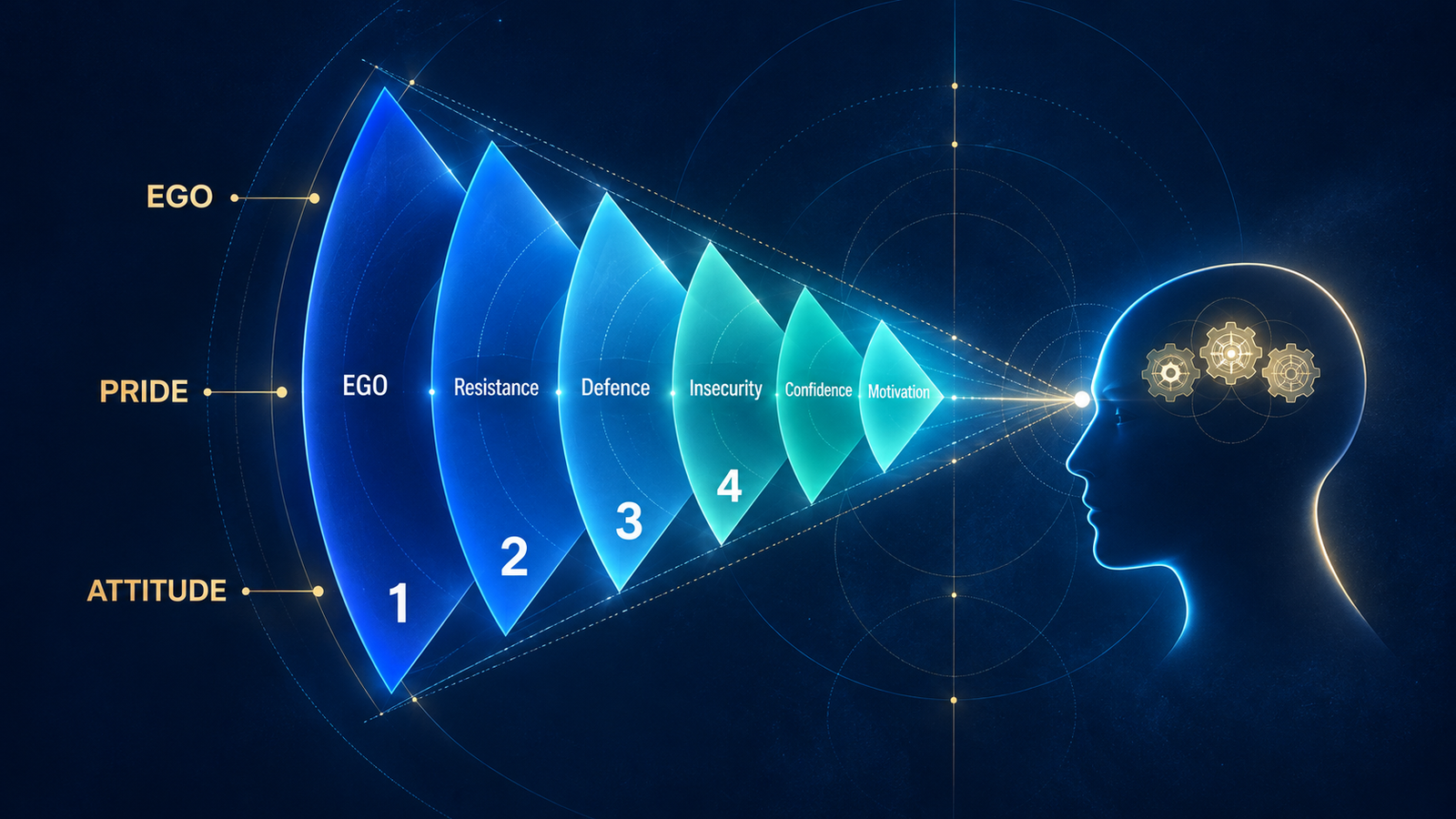
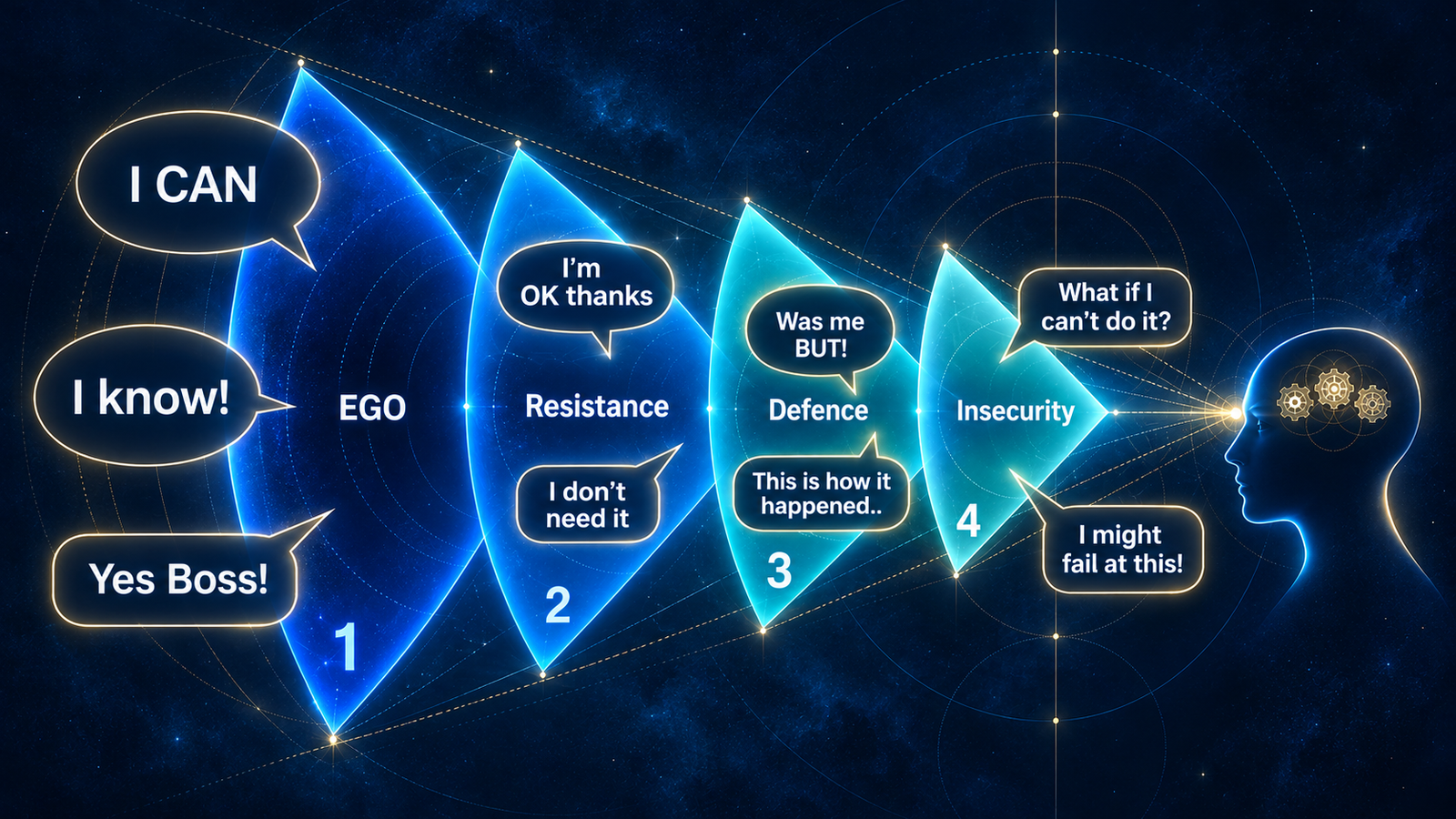
The Barriers Within
Not every barrier we encounter exists in the world around us.
Some arise through the ways we have learned to protect ourselves.
A threatened self-image may resist change. Uncertainty may awaken insecurity. Past experiences may encourage us to defend what feels familiar.
Yet these responses are not necessarily enemies. Many developed for understandable reasons.
Through observation, we may begin to recognise when a protective response is helpful — and when it has become unnecessarily restrictive.
04
Changing the Station
Sometimes a change in perspective feels like discovering an entirely different world within the same circumstances.
Imagine turning the dial on an old radio.
The receiver remains the same, yet what you hear changes as you move from one station to another.
I used a similar analogy in my earlier writings when exploring emotional associations, fear and desire.
The comparison was intended to illustrate how we can become accustomed to particular ways of interpreting experience.
A familiar expectation may direct our attention towards confirming it.
An old disappointment may influence our response to a new opportunity.
A long-held belief may quietly shape what we consider possible.
But what happens when we begin to question the interpretation itself?
We may discover that the event and our understanding of the event are not necessarily the same thing.
The past cannot be rewritten. Yet our relationship with its meaning may evolve.
Changing the station, in this sense, is not about tuning the mind to a literal electromagnetic frequency.
It is about recognising that our present interpretation may not be the only one available.
A Moment of Reflection
Think of something you once believed strongly but now understand differently.
What changed?
Was it the event, the information available to you, or the perspective from which you viewed it?
Perhaps the greatest shift was not in the world itself, but in how you came to see it.
Developed from Processing the Unprocessed in MR-TF-V5.0.
05
Beyond the Words
Sometimes what we feel in a conversation seems more significant than the words being spoken.
Two people may use precisely the same words, yet leave us with entirely different impressions.
One may speak with warmth and sincerity.
Another may say something similar while appearing distracted, impatient or uncertain.
The words alone do not account for everything we experience.
Tone, expression, timing, attention and the relationship between people can all influence how communication is received.
In my historical writing, I explored this through the idea that feelings carry a resonance beyond language.
I used the example of saying "I love you" to question whether communication is simply a matter of words or something more deeply experienced.
The language of frequency offered one way of imagining that relationship.
But the essential invitation remains simple.
When we communicate, what are we bringing into the exchange?
Are we listening?
Are we present?
Are our words consistent with what we intend to express?
And how much of what we perceive in another person is influenced by our own expectations?
A Moment of Reflection
Recall a conversation that left you feeling understood.
What made it different?
Was it what was said, how it was said, or the quality of attention between you?
Perhaps communication begins before we find the words.
Developed from B2-013 FIJLI 0001.
06
The Inner Signal
What is the quality of attention we bring into the experiences of our lives?
Throughout these explorations, we have considered thoughts, emotional patterns, openness, resistance and the ways perception may change.
They share a common thread.
Our inner state influences how we engage with the world.
This does not mean that our thoughts control every event, or that difficult circumstances arise because we are somehow operating at the wrong frequency.
Life is far more complex than that.
But there may be value in recognising the orientation from which we approach our experiences.
Are we responding from curiosity or expectation?
Are we listening or preparing to defend?
Are we allowing something unfamiliar to be considered, or dismissing it before we have fully understood?
These questions do not require us to become permanently positive, peaceful or aligned.
They invite us to become more conscious of what is already happening.
In my earlier writings, I explored fear, desire, love and growth through the language of energy and resonance.
Beneath that language was a question that continues to interest me.
What becomes possible when we recognise the inner patterns influencing our choices?
Perhaps the answer will be different for every visitor.
And perhaps that is exactly as it should be.
A Final Invitation
Return to the question with which we began:
What if the world we experience is influenced not only by what we do, but by the state from which we do it?
There is no prescribed answer.
Only an invitation to observe, explore and discover for yourself.
07
The Limits of Perception
We may look at the same world, yet experience it differently.
Our eyes capture only a small area in sharpest detail at any one moment. Beyond that, our attention, expectations, memories and experiences influence what we notice and how we interpret it.
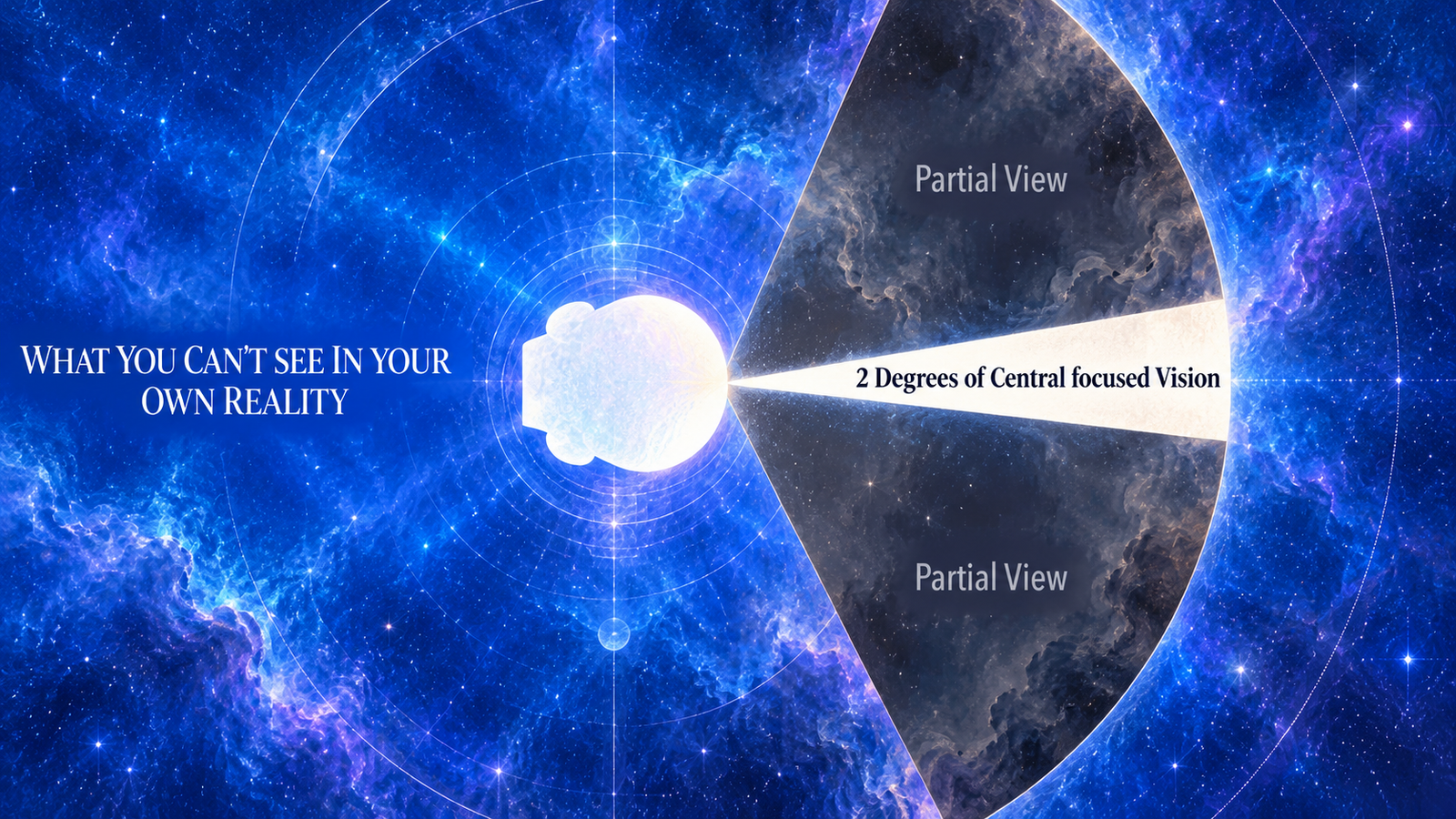

The approximately two-degree region refers to our sharpest central vision, not the total extent of human sight. Peripheral vision remains active and important.